
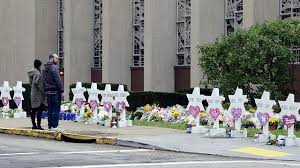
More Jews murdered for being Jewish. Shouldn’t this have been eradicated after Jewish people the world over were subjected to so many horrors in the 20th century? I guess not. Remember how we sat on the floor during Eicha on Tisha B’av and understand that this is not a new reality – unfortunately.
* * *
Tree of Life-Or L’Simcha Congregation. An early fall Shabbos morning. A Conservative synagogue in the “leafy” Squirrel Hill neighborhood of Pittsburgh, Pennsylvania, an old and close-knit Jewish enclave – much like Park Heights, perhaps. Founded as an Orthodox congregation in 1864, the congregation moved into its present building in 1953. It merged with Congregation Or L’Simcha in 2010, bringing its membership to 530 families. Fortunately, only a few people were at this minyan. It was a day of celebration. Mazal tovs were being bandied about. Most of the regulars were there, old-timers and mainstays of the minyan, salt-of-the-earth types. Their stories are beginning to be told. Eleven beautiful Jews murdered on the Sabbath, of all days. Others horribly injured. Wonderful people, who loved their Judaism, slain in a shul they loved. Echoes of Har Nof.
Nor is it the first murder of Jews in America. There were fatal shootings at the JCCs in Los Angeles (1999) and suburban Kansas City (2014), and the Jewish Federation of Seattle (2006). In 2009, a white supremacist murdered the security officer at the U.S. Holocaust Memorial Museum in Washington. These have been many other, lesser anti-Semitic incidents on campuses and communities. In Europe, the ever-present, overwhelming terror threat to Jewish communities means that Jews in France are afraid to walk the streets for fear of being attacked for who they are – much less go out in public in a kippa or tzitzis flapping. And in England, you have the leader of the Labor Party, who is ideologically anti-Israel (likely a mask for Jew hatred). Is this what we in the United States of America should be worrying about? Is this where we are heading? Like Toulouse, Paris, London, Brussels? We pray not.
When all the “thoughts and prayers” on Facebook and Twitter disappear, when the candles burn out, when the vigils are over, what are we Jews supposed to know and do to protect ourselves in our community, our shuls, and our homes?
We spoke with Ronnie Rosenbluth, a founder and former president of the Baltimore Shomrim Safety Patrol, to gain some clarity over these and other security issues facing Baltimore’s Jewish community.
SW: Can you give us a safety perspective on a person going to pray or learn in a local shul in Baltimore?
RR: People should feel very safe going to their shuls on a regular basis. Yet we want people to be very aware of their surroundings. During your regular Shabbos walk or your drive to shul during the week, be conscious of new people or cars you have never noticed before near the shul. Does something look out of place? Is there something that shouldn’t be there? Maybe you notice a car without a license plate driving slowly. We should be consciously thinking of these things.
SW: Sounds like “if-you-see-something-say-something” thinking.
RR: Well, that’s true. It’s a logical approach. Who do you say it to, though? People call Shomrim regularly to report suspicious information. Houses can get burglarized during the day, when people are at work. Criminals may know you have a weakly enforced side-door, for example, and target your house. Calling Shomrim is very helpful. Dash-cam videos from a car can be very helpful, as well. They are like additional eyes. People might forget the vital information that we need to report to the police when they call us. We could give that information to the police. Maybe another citizen in our community will then notice that same car and follow up by calling the police as well. This can be of great assistance to crime fighting. Everyone, on his or her regular drive to the supermarket or the bank, can add additional eyes to help Shomrim and local law enforcement.
SW: What kind of plans can you recommend for synagogues? There are shuls in New York City training volunteers to assist in security. Can we implement that here?
RR: Each shul has to come up with its own plan. I’d be more than willing to help with that plan, if needed. A large shul with 500 members is drastically different that a small shtieble. The layouts are different. The exits are different. People need to know what to do in the event of an emergency. Local schools have lockdown protocols and shelter-in-place standards in case of emergencies. Many shuls do not have that – and they should.
Maybe a phone could be installed that dials directly to 911 for an emergency. (We already have phones that call Hatzalah directly.) If an incident happens on Park Heights Avenue maybe the shuls on Greenspring Avenue should know about it immediately. Right now, there is a Shomrim member in almost every shul. The few shuls that don’t have Shomrim members are still close enough that they can receive the pertinent information as well. Shomrim is working on a plan right now to see who from which shuls can spread the information to those shuls that do not have a Shomrim member. We want the information relayed very quickly. Each shul should have its own security task force to make decisions in case of emergencies.
SW: Can you speak towards gun ownership in the Jewish community of Baltimore?
RR: There are certainly Jewish community members who own a firearm – probably more than people realize. In fact, unfortunately, in the last four days, four guns have been stolen from Orthodox people’s homes, in burglaries. The concern that came up today is, do these criminals breaking into the houses know that guns are in the house or not?
Many people own gun safes, but maybe they are not using them properly. Maybe they are not storing the gun away immediately when not on their person. This is terrible. If you speak to professionals, they will advise you to always keep your guns locked up! Not only to protect innocent people from getting hurt but also to protect the gun from being stolen in a crime. These gun thefts are a new phenomenon in our community. It used to be that criminals would look for jewelry or other valuables to grab. We think we know how smart we are when we lock up our jewelry in “obvious” places. Well, this may not be so wise. Remember, the burglars know the obvious places as well. We find that they go through all the obvious, and even some non-obvious places, to look for valuables to steal.
SW: Can you give the local laypersons some ideas or tips on how to protect themselves, their families, and their communities? Remember, they may not be trained in law enforcement tactics. They just want safe homes, safe shuls, and safe neighborhoods.
RR: I would say that alarm systems are vital. If an alarm goes off, the criminals tend to flee. All doors and all windows should be locked. Check and double-check to make sure that everything is locked. You can have someone from a security organization, or even the police department, come to your house and show you where the weak spots are. About a year ago, Councilman Schleifer went around with the sheriff’s department to show people how to secure their doors and windows properly. It’s not cost-prohibitive; it’s just being smart.
Many times, you’ll see the old-time kitchen doors in Baltimore homes. Maybe these could be reinforced to make sure they are stable and strong and not easily broken into. Many robberies are of the smash-and-break type. A criminal could kick in the door – the side doors especially.
Cameras are a great idea to protect homes. And many people are using cell phone notification programs like RING, where if someone rings your doorbell or is in your walkway, you can see who that person is. Whether you are at home or not, you can be aware of what’s happening in your house.
SW: Any final thoughts you can give to the readers? Any lessons learned from the past incidents in the Jewish communities around the U.S.A.?
RR: We want to make people going to shul as aware as possible of safety and emergency protocols to be followed. We have many people going to shul who may not be paying attention to these standards. We want them to be aware and proactively conscious of what to do. Maybe we could put information up on a bulletin board or give speeches that would give congregants more vital information on how to protect themselves in emergencies.
In Shomrim, we also take up every case that comes up around the country and see what we can learn from it. We deal with Shomrim, or organizations like Shomrim, from all around the country. We share information with them; they share information with us. If we learn to do something a little bit better, or a little bit quicker, it is a net gain. If someone had a situation in their city, and then we have a similar one, we’ll call them and find out how they handled it, and compare notes. We debrief after our incidents so we can improve on our assistance to the community.
SW: Thank you for your time and service to the community.
The Where What When looks forward to reaching out to other organizations and professionals to continue the vital discussion about security in our community.