As a longtime resident of Israel, I guess I’ve come a long way since the days when I viewed all Jews not from Kovne, Lithuania, as horse thieves. Yes, I can certainly pat myself on the back now for having become the tolerant lover of all Jews that I know myself to be. Yet it didn’t happen in a day.
I can still recall, as a boy in frugal, Litvishe Baltimore, people’s disdain upon hearing of families that had married out – that is, their sons had married non-Litvak, non-Baltimorean, Brooklyn girls, and had been pressured by the girls’ families not only into holding their weddings in Brooklyn (Oy vey! Why didn’t they compromise on Wilmington?) but to holding lavish affairs with Viennese tables! – heaven help us.
But as I said, G-d has been busy reeducating me. My most important yeshiva rebbe was, and still is, Hungarian; ad meah ve’esrim; New York Galicianers taught me how to hug other men and bare my emotions; and finally, I married a Romanian, so in the end, maybe I learned that horse-thievery really isn’t all that bad.
Israel, as well, has fostered my ethnic tolerance. My main Torah teacher over the past 30 years has been a Turkish rabbi. For Baltimoreans, used to saying hello to strangers and mere acquaintances on the street, and used to giving hearty yashakoachs to everyone who gets an aliyah in shul, you certainly find that the North Africans are closer to the Baltimore model than the Europeans, so the categories start to lose their meaning, for what importance is there to my being an Ashkenazi if I am more on the same wavelength with the Sefardim?
As time has passed, I have seen more and more Ashkenazim and Sefardim intermarry. Indeed, many young Israelis already defy a category. More and more, the younger Israelis in my circle are three-fourths this and one-fourth that. You can no longer tell “what they are” by talking to them or by looking at them. You’ve got to wait for them to get an aliyah, and see if they add the word “Rabbanan” before starting “Borechu,” because that’s the level of the differences you are left with.
Thus, I am increasingly being conditioned to viewing the future of the Jewish people as involving the physical fusing of communities, with communal customs being preserved through the patrilineal line. In fact, I have grown not only to expect this to occur but to welcome and embrace the idea that it may someday involve my own family, as it already has my sister’s.
All that said, the people marrying off their children today are in their forties, fifties, and sixties, and some of the more salient stereotypes do continue to find at least superficial expression in the way people behave. If Rav Kook hoped that the ingathering of the exiles would introduce positive traits brought from all over the world, humor writer Ephraim Kishon famously expressed the fear of exilic communities coming to Israel and influencing the country with their worst traits.
Thus, four months ago, when my son announced that he wished to become engaged to the kind, G-d-fearing, erudite girl he had introduced us to a month earlier, a girl with a Moroccan father and a long-deceased Yemenite mother, I was quite pleased to be uniting with the Jewish people. Yet I felt the slightest bit wary as well. The kinds of things people used to say about those non-Litvak Brooklyn weddings they still say in Israel about Moroccan weddings.
In a word, the prevailing stereotype about Moroccans and some other North Africans is that, for them, if a wedding doesn’t put them far into debt, it just isn’t any fun. For a frugal Litvak Baltimorean, this is disconcerting, because weddings tend to be made by two sides.
But, of course, these are all just stereotypes, and I wasn’t going to believe them without asking some advice. So I talked to my Turkish rabbi friend and teacher, Rav Eliezer, who happens to be married to a Moroccan woman himself, and I asked him, “Tell me, Rav Eliezer, the bride’s father Daniel is Moroccan. Is there anything special I should be prepared for before we meet and discuss wedding arrangements?”
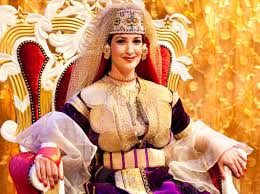
Rav Eliezer looked at me and said, “He’s Moroccan, which could mean he wants a lavish wedding, but that’s not all. He’s also been a widower for 10 years, since his daughter, the bride, was 10 years old. He will feel as though he has been both her father and her mother. Also, since she’s the oldest sibling and has helped in raising her younger siblings, there is even greater significance to who she is. In short, your mechutan, as a Moroccan, and as a widower in a special situation, will feel that he is marrying off his princess, and he will want the wedding to be extra special.
“My advice to you is this: Do not flaunt your money! At the same time, try to go with the flow. Let him take the lead. Try to be generous. If your mechutan suggests an expensive hall, try not to flinch. Try to do what he wants. It will be important to him, and it will save you a lot of unnecessary and untimely aggravation.”
There was some other advice about elaborate, ceremonious, Sefardic ritual, but I was intrigued by the first part, and curious to see whether it would prove relevant.
We had our first meeting with the kalla’s father, the widower Daniel. I hugged him (thank you, New York friends). We heard colorful stories about the bride’s enormous family, spread over the entire country but centered in the Tel Aviv area, and about their fascinating aliyah in the 1950s. Thus, we not only survived the first meeting but enjoyed it.
Daniel actually encouraged the young couple themselves to take some of the responsibility for finding a hall. I heard the couple talking quietly about Mesamchin, an organization that makes less expensive weddings possible, and I thought to myself, “Well! This looks like it is going to be easier than I thought.”
Since we are from a Judean town south of Jerusalem, and since the bride is from a Samarian town north of Jerusalem, I began dreaming about a frugal Jerusalem wedding, and I was quite pleased.
It was not to be.
The phone call came after 10 days, when the couple had not yet found a hall. It was my son, and he sounded a bit nervous. “Dad, we’re at a hall in Bnei Brak with Malka’s father.”
“Bnei Brak? Why Bnei Brak?”
“Dad, here’s her father. He wants to talk to you.”
Suddenly, Daniel was on the line, and he sounded excited.
“Moshe! We’re at the ‘Golden Palace’ wedding hall in Bnei Brak. It’s a wonderful hall, with the supervision of Rav Lando! We made a bar mitzva here, and it was really nice! The normal price per plate is 200 shekels, but I can get them down to 170 because I know someone on the staff. Can you handle this?”
Because I had gotten advice, I was psychologically prepared, and I did not pause for more than half a second.
“Daniel, if marrying off your princess in the Golden Palace in Bnei Brak will make you happy, then it will make us happy as well! Don’t worry, we’ll manage our part.”
“Thank you Moshe! Thank you,” responded Daniel. He sounded overwrought.
My sister, who has made a number of such weddings with Sefardim, gave me high marks for my response.
It was a lovely wedding, at the end of which my sister approached the widower Daniel, and said, “Everything was so beautiful! The dancing was wonderful! Everyone looked so happy! The bride looked ecstatic! The ceremony was so moving! And the food was good too.”
Daniel caught the irony in my sister’s voice. But he responded very seriously, “I’ve got 600 relatives for whom the food is everything, and if I don’t provide, they’ll feel insulted.”
When my sister told me this, I had an insight. Daniel was standing on the outside as well. He, too, was afraid of doing the wrong thing, and felt compelled by circumstances to do things he might have preferred not to.
Forty years ago, I heard Professor Sidney Mintz give his introductory lecture at the start of his basic sociology course. He said, “Man is compelled by the sociological forces around him to behave a certain way. He has no free will.”
I do not know whether Professor Mintz’s statement about our lacking free will jibes with the Torah viewpoint. In fact it might very well not. But my point is this: When you think back on those Brooklyn weddings you had to schlep to from Baltimore, with their Viennese tables, try to be kind.
The author of this article has chosen to hide his identity, using as a pen name, the name of his great-great-grandfather, who came from Kovne